
Watching the World Cup this summer, I couldn’t help but notice the ads for AI. They were everywhere, most prominently in the form of Google Gemini as the lead sponsor of ITV’s coverage in the UK. It didn’t seem to matter that there was no link between Gemini and football, we were still encouraged to summon the app ‘for every goal’.
In the associated full length ad, a series of people overcome their ineptitude with a little help from Gemini, including Harry Kane. Unable to find anything football related to make use of his skills, he is shown asking Gemini to help him schedule the food prep for a barbecue. (This, by the way, is a good way to give your guests food poisoning.)
This is of course the latest round of AI promotion, which has always smacked of desperation to my mind. It’s been thrust into applications where we’d never needed it before. We are ambushed by it on Amazon, as if we are incapable of doing our own shopping. Search engines hack together an AI summary that may or may not be useful. Word documents open with a variety of suggestions, as if we open new documents and then decide why afterwards. I don’t remember previous generations of technology being quite so aggressively pushed at prospective users. It’s as if – whisper it – the AI companies know that most of their tools aren’t really all that useful.
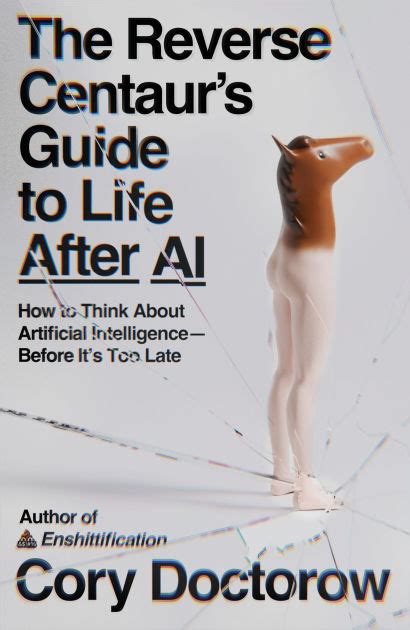
Cory Doctorow’s new book, The Reverse Centaur’s Guide to Life After AI, has an explanation for this. Cramming AI into everything isn’t for you, he suggests. It’s for the shareholders. A vast amount of money has been gambled on AI. Companies have to show the investors that people want AI, and they do this through engagement stats.
Lots of engagement with AI tools demonstrates how popular and useful this all is, so Google, Microsoft et al task their engineers with driving up engagement. It’s often a key performance indicator, something they need to deliver if they want to keep their jobs. One easy way to game the engagement stats is to make AI an opt-out feature rather than an opt-in one, basically a very expensive internet pop-up.
If the tech companies can’t show increasing engagement, the investors will panic and sell before AI ever makes any money. Almost no AI companies are turning a profit right now – OpenAI burns $20 billion a year, xAI loses a billion every month, and the industry as a whole is on track to lose $700 billion this year. The moment the investors lose confidence, it’s over. And this is why big tech is so painfully needy: please, please please just push the colourful button and do something – anything – with AI.
Doctorow suggests that we should ask specific questions about any new technology. “Stop thinking about what the gadget does, and pay attention to who the gadget does it to, and who the gadget does it for.”
In this case, AI is serving capitalism.
Not you, not human progress, not some ideal of efficiency or convenience. Fundamentally, AI as it currently being pursued exists for the primary purpose of making more money for people who are already very wealthy.
This is where the reverse centaur of the title comes in. In technologist slang, good technologies make us like centaurs – a human with the advantages of a horse’s speed and strength. A person using binoculars or riding a bike is like a centaur, as the technology amplifies their human faculties.
A reverse centaur, on the other hand, is a horse with human legs. It’s a backward configuration that makes the human a servant of the technology – a person addicted to the endless scroll of social media, for example, or a delivery driver at the mercy of an app. The big tech version of AI risks making us into reverse centaurs, an imposition on society for the benefit of the richest.
AI could be done differently, Doctorow argues. Open Source AI projects are evidence of that. So is Deepseek and other Chinese disruptors. These lighter weight and more adaptive AI applications are more likely to survive the popping of the bubble, while the big cloud-based American model will collapse and take the stock markets with them. Hence the ‘life after AI’ bit of the title. There will be plenty of useful AI tools for us to use on the other side of the coming crash, though the disruption will be immense. Some of the world’s most valuable companies are likely to fail, with the AI bubble taking its dishonorable place in history alongside tulip mania, the Wall Street crash of 1929 or the derivatives scandal.
Cory Doctorow’s theory of ‘enshittification‘, explained in the book of the same name, articulates something that I’d been seeing everywhere online. His new book applies that theory specifically to AI, and it’s well worth reading. Other opinions on AI are available and it’s by no means the last word on the subject. What it does well is move the conversation around AI from simple questions about whether it’s good or bad, and locate it within capitalism and the drive for economic growth. With that in mind, we can ask better questions about who AI serves, and interrogate the underlying power relationships behind the AI boom.
- You can pick up The Reverse Centaur’s Guide from Earthbound Books
- I don’t generally use AI tools on the blog, but it felt appropriate to ask Google Gemini to generate a suitably apocalyptic header image.

