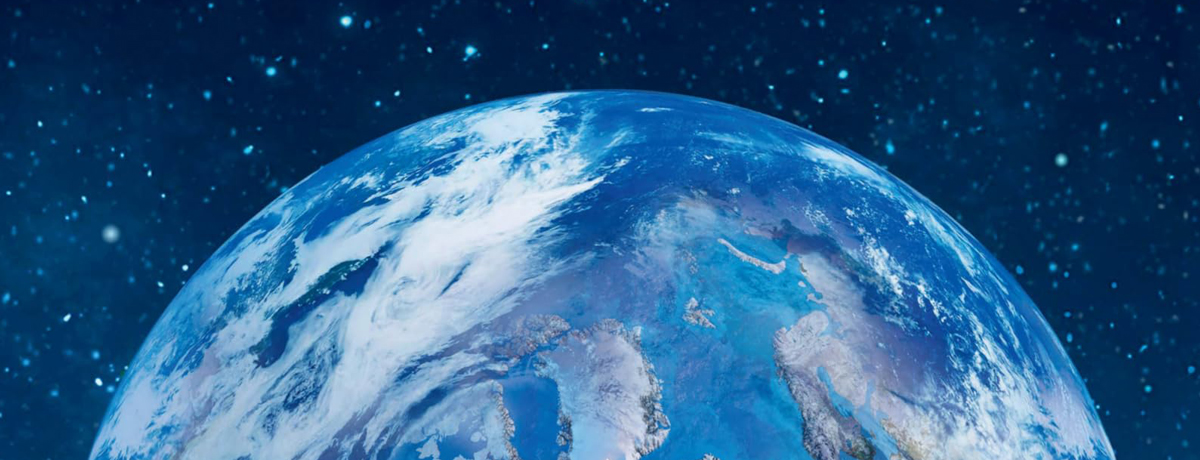

For someone who has made a career out of big and bold ideas, this must have been an irresistible one: pitching a new name for the planet. That is indeed the proposal here. Humanity has misjudged the nature of our planetary home. We had always thought of it as terra firma until we saw it from space for the first time. Seeing it whole and from a distance, it’s clearly a water planet – uniquely in the solar system. Plenty of planets have solid ground. It’s water that makes it special, and so we should think of Earth instead as Planet Aqua.
That sounds like the kind of thing you might hear as a thought-provoking quip at a conference, but Rifkin is serious. “Rebranding our home in the universe as Planet Aqua, and introducing this second naming of our planet into government constitutions, bylaws, codes, regulations and standards, is the first giant step toward a realignment with the waters that animate our very existence.”
The book leans into the idea and argues the case from a number of angles. There’s the fact that life progressed from water originally, something the ancients might have understood better than us. The writer of Genesis describes the spirit of God is hovering over the waters, Rifkin points out. The evolutionary story leads from water onto land, and all land based life still depends on water from somewhere.
All human advances have progressed from water too, in what Rifkin calls ‘hydraulic civilization’. People settled near water, moved inland along rivers. Cities depended on taming and controlling water through dams and aqueducts and irrigation. We used water for transport. We used it for energy, with water wheels and then hydroelectric. Human history revolves around water management.
Another reason we need to think about this now, Rifkin argues, is that taking water for granted has backfired. As the climate changes, the waters are rewilding. Our hydraulic civilizations are at risk in new ways, with floods and extreme rainfall or shortages and drought – unpredictabilities that our cities and systems weren’t built to handle.
In response, the book argues for a re-centering of water in our understanding of ourselves and our place in the world. The waters need to be set free, and we need to live alongside them rather than seeking in vain to contain and control them. Rifkin describes dam removals, letting rivers wander, restoring wetlands. In urban environments, rain gardens and sponge cities show how we can live with the waters in imaginative ways. Vertical farming offers less water intensive forms of farming. On the social side, it’s good to see a discussion of climate passports for a changing world, referencing Gaia Vince’s recent book Nomad Century.
Alongside these ideas, readers are also treated to all manner of esoteric sidelines, as the book skips from history to science to myth to speculation about the future. There’s a chapter that wanders from gender relations to romantic poverty, to cultures of swimming to whether men think about the Roman empire. A philosophical section ponders maps and clocks, the creation of calendars and the French revolution’s experiment in decimal time. It ends with the rather vague justification that we ought to “incorporate water themes into our calendrical life”. Depending on your preferences as a reader, this is either fascinating or frustrating.
More seriously, the rhetoric regularly veers into overstatement. We are already moving “from capitalism to hydroism”, Rifkin announces, which will come as news to basically everyone. Another section declares that “the entire human-built environment is now a stranded asset and will have to be rethought,” which is a sweeping statement of cosmic proportions.
At least Rifkin has the courage of his convictions, though personally I’m not entirely convinced. To me the name Earth refers to soil as much as land generally, and soil is unique to our planet and vibrantly alive. Whatever our origins and dependence on water, humans remain land-based creatures. We are only ever visitors to the water, splashing about on its surface. Given that any name we ascribe to the planet is entirely a human device, why shouldn’t it reflect our human experience of living on it?
So while I won’t be adopting the new name, I don’t begrudge Rifkin his thought experiment or the time I spent reading it. If you’re drawn to big reframing narratives, they don’t come any bigger than questioning the very ground we stand on.
- You can get Planet Aqua from Earthbound Books.
- See also: Wallace J Nichol’s exploration of water and psychology in his book Blue Mind.
- My review of Jeremy Rifkin’s The Age of Resilience.
 The Earthbound Report