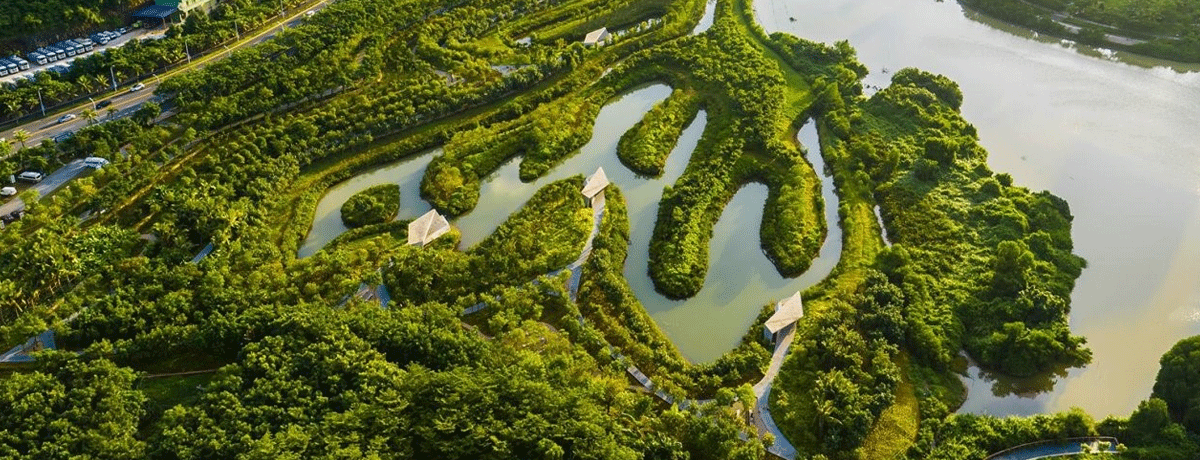
How many landscapers are there who are household names? Others will have names that come to mind, but in the English speaking world it’s a pretty short list. There’s basically room for one per century, starting with Capability Brown. He seems to have designed the grounds of every other stately home in the nation, and made a well-kept lawn the foundation of all English gardens to come.
The 19th century entry would probably be Frederick Law Olmsted, co-creator of New York’s Central Park and for some reason better known than the other guy who worked alongside him – Calvert Vaux, thank you Wikipedia. It wasn’t the first urban park, but it was the template for many afterwards. Where Brown’s work was all about elite fantasy landscapes, Olmsted’s was for the people. Urban parks were oases of calm and nature for everybody, a response to the industrialisation and urbanisation of the age.
For the 20th century I’d say Ebenezer Howard, though he is more of a planner than a landscaper per se and probably not famous enough to be a household name. He invented the ‘garden city’, which in turn spawned the idea of the suburbs. Stripped of his idealism and social reforms, Howard’s vision accidentally gave us suburban sprawl and car dependency. He has been spectacularly influential in ways that would make him very sad.
All three of these men shaped both the landscape and what we see as desirable in it, for better or worse. All three had an influence well beyond their immediate projects. Directly or indirectly, their ideas have ordered the geography and therefore the life experiences of generations of people – maybe billions at this point.
2025 is early to pick a name for the 21st century, but there may be a contender in Kongjian Yu. I’ve written about him before, as the originator of the ‘sponge city‘ and designer of many a colourful riverside sponge park. His design practice has delivered hundreds of projects across Chinese cities in the last 15 years, applying a series of techniques for slowing and absorbing water to prevent flooding. They work, the Chinese government has adopted them as policy, and his ideas are spreading around the world.
Like the other names mentioned above, Yu hasn’t been working in a vacuum. The term ‘sponge city’ was coined in the 1970s. Various places have developed techniques to allow public spaces to safely flood, notably the Netherlands. Yu has perfected the techniques, specialised in them, and popularised them. Because so many Chinese cities use the sponge playbook, hundreds of millions of people are benefiting already. There will be more.
Warm air holds more moisture, so climate change leads to heavier rainfall. More cities will need to learn to cope with rain storms that they weren’t designed for. Older techniques to defend against flooding will fail, to be replaced by resilient systems that manage water rather than resist it. Yu’s sponge city philosophy may well become standard practice for city planning, especially in coastal and riverine cities.
That’s all for the future. What prompts this post today is that this week Kongjian Yu was killed in a plane crash in Brazil, while filming a documentary about his work. His last projects are now in the hands of his 500-strong team at Turenscape, and he leaves behind a rich body of work – both physically built and in writing. There is a huge amount to draw on and learn from. In a warming world, his influence is likely to grow. If you’ve got five minutes, take the time to let Yu explain his philosophy in his own words:
 The Earthbound Report