One of the big hesitations around solar farms is that they take up land that could be used for food production. It’s an argument that’s made by climate sceptics who oppose renewable energy, but those on the green side of the equation worry about it too. My response has always been that if you’re displacing food production for solar, you’re doing it wrong. You can do both at once, in many different ways. In some contexts solar makes farming possible on land that would otherwise be unproductive, and China has shown how solar farms can regenerate deserts.
There is, however, another important consideration that Bill McKibben describes in his book Here Comes the Sun. He suggests that you can think of any field as a solar farm. All plants take in sunlight and turn it into products that we want. They use about 1-3% of the sunlight that falls on them, whereas a solar panel uses around 20%. So if we think about using the sunlight falling on the land rather than the land itself, solar panels are more efficient.
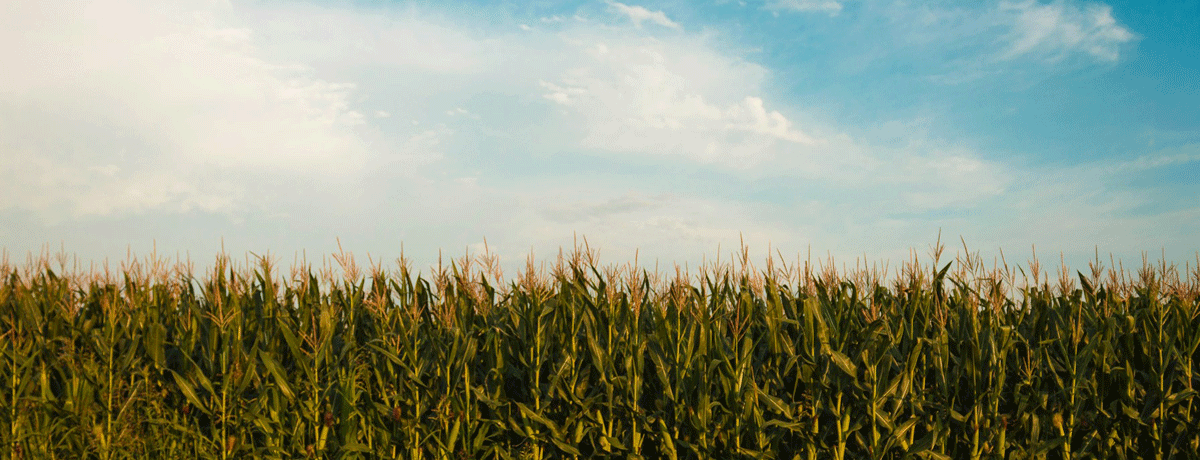
You can’t eat solar power, which is where this argument might fall down – except that lots of farms aren’t producing crops for eating anyway. In the US, 40% of all corn crops are grown for biofuel ethanol. This is the comparison we should keep in mind, McKibben argues: a field full of solar panels, and a field growing corn for ethanol. Since both are being used to produce energy, which one is more efficient?
The answer is solar, which produces 100 times more energy than biofuel ethanol.
“An acre of corn will produce enough ethanol every year to drive a Ford F-150 pickup about 25,000 miles,” says McKibben by way of example. “Cover than same acre in solar panels and you will produce enough juice to drive the electric version of the same truck – the F-150 Lightning – about 750,000 miles.”
Thought of this way, it’s possible that solar farms could have the opposite effect of the one we fear. They could actually free up farmland, provided they are part of a holistic energy transition that includes the phasing out of internal combustion engines. A recent study from the US state of Wisconsin makes this point. The state currently has a million acres of land growing corn for biofuels. Meeting the state’s clean energy targets with solar power would take 285,000 acres. That’s less than a third of the land currently growing biofuels, leaving the other two thirds to grow food or to be turned over to wildlife.
For the UK, we currently have over 350,000 acres producing energy crops, 30% of which is biofuels for transport. Solar farms, for comparison, currently occupy 52,000 acres. These, I remind you, can all still produce food if we use agrivoltaic methods.
If you are concerned about the loss of farmland for energy, support the shift away from internal combustion engines.
 The Earthbound Report
Really interesting perspective. Thinking of farmland as “solar capture” makes the comparison much clearer—especially when you bring biofuels into it. If land is already being used to produce energy (like corn for ethanol), then solar is obviously far more efficient. The key point for me is that it doesn’t have to be either/or—agrivoltaics show we can generate energy and still keep land productive. Commercial solar panels