A few years ago there was an extensive round of consultations around expanding Luton Airport. I went to several of them to cause trouble with the local Extinction Rebellion group, and would attend dressed as an elephant or an air traffic controller. At one of them I created a sit-in of soft toys with my children, and we put teddy bears holding protest signs on the tables. And at some of them I went along as an ordinary citizen with questions about the wisdom of expanding airports at a time of climate crisis.
A recurring argument in favour was that electric planes were on the way. They were imminent, practically on the horizon. By the time the second terminal was in operation, an estimated 2034, the transition to electric flight would be well underway. We could expand the airport without increasing emissions. I heard this fantasy reasoning from councillors, planning officers, the airport operator and from well meaning friends who backed the expansion (jobs! growth! etc).
This wishful thinking was actively encouraged by Luton-based airline Easyjet, whose PR efforts around electric planes look carefully timed. In late 2017 they made a big splash with their announcement that they had a plan: they had partnered with a start-up called Wright Electric, and they would develop an all-electric passenger jet within a decade. “It is now more a matter of when, not if, a short-haul electric plane will fly,” said the CEO.
The ‘electric flight within a decade’ hook was widely featured in the press. The Guardian reported it with no further questions. So too the BBC, while The Sun ran with the headline ‘easy peasy’. None of the journalists interrogated the claims – not the fact that it takes $10-30 billion to bring a new commercial airliner to market, which is a tall order for anyone, let alone a start-up. Not the fact that even the aviation giants of Boeing and Airbus can take a decade to develop a new airliner. Not the fact that Wright Electric said they had a two seater electric prototype already, but released no pictures of it. (There are still no pictures of this plane on the internet.)
So, nine years into that decade, is that electric plane any closer? Should we expect a maiden flight in 2027, and a roll-out across Easyjet’s fleet from there?
To trace the journey, Easyjet mentioned their partnership with Wright a few more times in the next couple of years. They harvested another round of headlines in 2020 with some design concepts, and announced an engine testing lab in 2021.
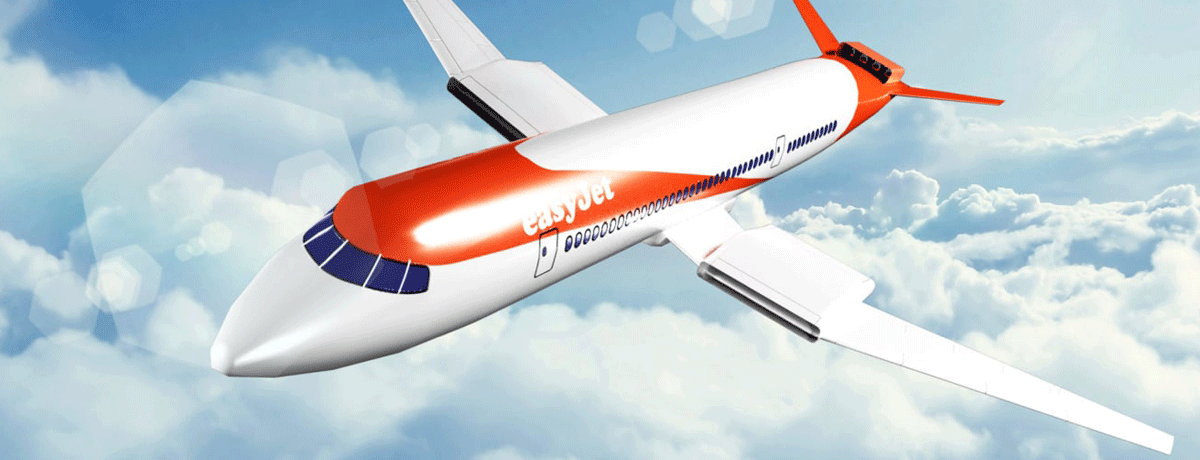
Wright then decided that they wouldn’t attempt a whole new plane, but would retrofit a hundred-seater BAe-146 instead. The plan was to swap in one of the four engines for an electric motor. Then you could try two, and so on until you had a proven all-electric plane, though they admit that it would likely remain a hybrid. Called the Wright Spirit, this is what will be flying by 2027, not the sunlit artists’ impressions released to the media.
That’s moving the goalposts somewhat, but that would still be progress and I’d be prepared to give them the benefit of the doubt. The last I heard was that the motor had been simulated, then tested. The first actual flight with one of its electric motors was initially scheduled for 2023-2024. That hasn’t happened and 2027 feels like a stretch.
As for the Wright 1, the concept plane that was press released with Easyjet graphics, that’s now being talked about for 2032.
Have Wright Electric actually flown any electric planes yet? Why yes! Here it is.
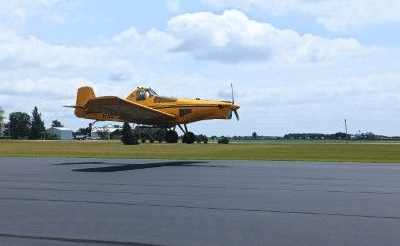
That’s a hybrid crop duster, taking a test flight in 2023. I may be wrong, but to the best of my knowledge that’s the only actual plane that’s flown using Wright’s electric propulsion tech so far.
Easyjet didn’t issue a press release to celebrate this milestone, and not just because that’s an ugly plane and only has room for one person in it. They didn’t press release it because they’d already given up talking about Wright Electric and their potential airliner.
In 2022 Easyjet announced a partnership with Rolls Royce to develop hydrogen aircraft. They expect to be flying zero emission hydrogen planes “from the mid 2030s”.
Do I believe them this time? Not really, though they have a better chance with this one than their previous claim. I don’t believe that they were ever serious about electric planes within a decade. I think it was a PR gambit to build the case for airport expansion, and to keep the climate protestors and their tubes of superglue away from their front door.
However, I’m only disappointed because I care. Despite my cynical tone here, I do genuinely want them to succeed. From an entirely selfish perspective, I’d rather like to fly again. I want to take my children on more adventures, and I don’t want to do it until aviation is sustainable. I want the airport town I live in to be free of pollution and noise, and I would love it if Luton based companies were to lead the way on hydrogen and zero carbon aviation. Most importantly, I want a stable atmosphere and a liveable planet, which is why I’ll continue to keep an eye on the big orange airline down the road.
 The Earthbound Report