
I was travelling out to a school last week in Essex, East of London. My train had been delayed and I jumped in a taxi to get me there on time. The driver was a white man in his sixties, wearing a West Ham football shirt. In the course of conversation, and in-between some choice words on other drivers, he asked me where I was from and what brought me out to Billericay.
I will admit to a moment of hesitation. I was already stressed by the delays, and I didn’t want to let my colleague down by turning up late. I didn’t need the extra hassle of dealing with someone’s net zero cynicism, or having to defend the value of my job. I also knew I shouldn’t be judging the driver or assuming anything about his views, and that his honest curiosity deserved an straight answer.
I told him I worked for a climate campaign and was there to do a sustainability audit, and there was no roll of the eyes in the rear view mirror. Instead he told me enthusiastically about the solar panels he had installed on his house, how his daughter had come back from university and convinced him he should do it. As we pulled up to the school, he wished me well and discounted the fare.
It was a good reminder to me that stereotypes are lazy, and while we can’t prevent our brains from presenting us with cognitive shortcuts, we can and should resist them and treat people as individuals. Even West Ham fans.
It was also a good example of how important it is that people see the benefits of the clean energy transition for themselves. My driver had got his solar panels for free through an energy company scheme, and had saved thousands of pounds over the last decade. He didn’t need any convincing that renewable energy was a good idea, because he could see it working for him every day.
Unsurprisingly, people are more supportive of climate action when they will benefit from it, as polling from YouGov shows:
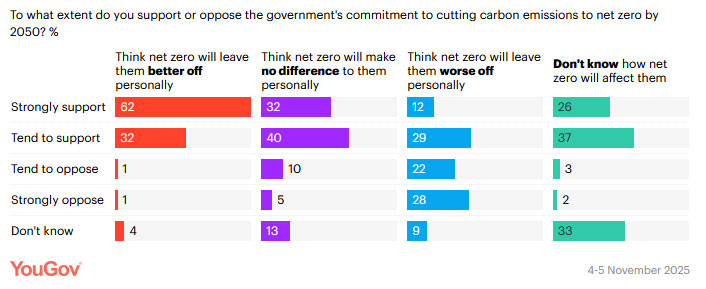
41% of people still support climate action even if it makes them worse off, which is higher than one might expect. But ideally we’d want to show as many people as possible that a sustainable future will be better for them, and it deserves their wholehearted support.
Environmentalism is too often framed around bans and taking away things that people like. Indeed, this same YouGov poll makes that mistake and goes on to ask people if they support banning meat, petrol cars and flying on holiday. Thanks YouGov. In reality the cheapest form of energy generation in the UK is onshore wind, with solar right behind it. Research from Auto Trader shows that the average electric car driver saves £980 a year. Done well, environmental policy can address the cost of living crisis, helping to reduce poverty and inequality.
Conversely, the climate crisis is a major driver of rising prices – particularly of food, but also in more indirect ways such as rising insurance premiums
This should be an easy sell, but we find ourselves in a strange place in the UK. People are struggling with higher energy bills, and yet the party doing best in political polling at the moment wants to ban the cheapest forms of energy generation. Likewise in Trump’s America, where hundreds of millions of dollars of taxpayer funding is going to suppressing cheap renewable energy and keeping the fossil fuel fires burning.
The Climate and Community Institute (CCI) is a US think-tank that argues for a ‘working class climate agenda‘ as the best reponse to this problem. Past climate initiatives in the US didn’t deliver tangible benefits fast enough to outlast the electoral cycle, and now they have been scrapped before they had a chance to prove their effectiveness. There’s a very real risk of the same thing happening in the UK. If the Reform party get into government, they have pledged to scrap the country’s climate policies and renewable energy strategy. So there’s an urgent need to demonstrate the worth of climate policy, and end the idea that it’s a middle class concern.
What sort of thing might that involve?
The CCI suggest that it would need measures that are delivered fast, that prioritise the public sector, and that shape flows of investment towards things that matter to ordinary people.
Practically, that could mean focusing on social housing, ensuring that those households are first in line for energy saving retrofits, solar and batteries. Bus travel is another natural priority, improving services and making them more affordable – or even free where possible. For those who can’t use buses or live in rural areas, charging infrastructure and help to buy electric cars can bring cleaner mobility there too.
To direct more funding towards the green economy, governments can use their procurement power and work with their supply chains to raise environmental standards. They can use government owned land and property to create green jobs in retrofit or in land restoration. Publicly owned banks and companies are a useful vehicle for raising investment too, as the UK is doing with Great British Energy.
These aren’t new ideas of course, but it’s useful to see them articulated really clearly for an American context. There’s no lack of real world examples in CCI’s paper either, with Zohran Mamdani’s priorities as mayor of New York perhaps the most high profile.
In the UK, I think the government is well aware of the need to demonstrate the value of climate policy for ordinary citizens, and this agenda is well understood. The question now is whether it can deliver on the first of CCI’s points, and act fast enough to beat the electoral cycle.

