If oil production is going to fall while demand rises, one of two things will have to happen. We can resist change, and swallow the cost, both in rising prices and in human suffering as wars for resources become more commonplace. Or, we can take steps to reduce our dependence on oil.
The first thing to do is look at where the oil is used, so we know where to focus our efforts. Here’s a graph of US oil use by sector:
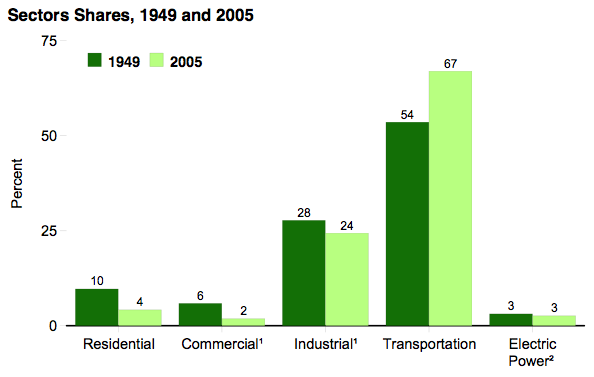
As you can see, oil use in the commercial, residential, and power generating sectors has fallen. Levels in the UK are even lower, as we don’t use heating oil to the same degree. Industry is still a big user, but transport is by far the biggest problem. To tackle the challenge of peak oil, we need to address car culture.
There are lots of things we can do here. One is to research alternative fuels. Hybrid and electric cars are a step in the right direction, the green credentials of hydrogen are still in question, although the technology is in use already. We’re already using 5% biofuels in all our petrol in the UK, and will be using 10% by 2010. This is reducing our dependency on oil, but at a considerable cost. The biofuels industry badly needs some international standards and regulation before it can be a real answer.
A more obvious step is greater efficiency. The oil squeeze of the 1970s was met with new and stringent efficiency rules. The car companies responded accordingly with innovations in engine technology. We can get more from the oil we have left, buying us some time, but it won’t come from the automobile industry left to its own devices. We are moving towards greater efficiency – we’re just doing it painfully slowly. The average BMW sold in 2007 was 7.3% more efficient that the average BMW sold in 2006, but Honda’s average efficiency went the other way, 1.1% worse. Vauxhalls became 0.6% more efficient, Ford 0.2%. That’s too slow. Legislation is required.
While we’re on the subject of government, I should also mention that the US still subsidises the oil industry, to the tune of around $250 billion a year (New Scientist, 28/06/08). That’s a pretty dumb thing to be doing. You could take those billions and put them straight into research into alternative fuels or subsidies for solar entrepreneurs.
We can also invest in public transport, perhaps with subsidies to lower fares, especially on trains, which are inexplicably more expensive that flying in the UK at the moment. The government could link road tax or fuel duty to public transport to aid funding, or even introduce a road-use scheme so that those who travel more pay more. Besides public transport, we can car share or car pool.
Even with improved public transport, we can all travel less. I’ve talked elsewhere about the hypermobile society, but that is something we need to undo. This may mean restoring high streets and local shops, rather than out-of-town supermarkets. It may mean new initiatives to create local jobs and reduce the need for long commutes.
More locally, we can reduce our dependence on oil used in transport by supporting local business whenever we can, particularly with food. This will keep fuel miles down, saving the oil spend in transporting goods around the country and the world.
And, to repeat something we say all the time: buy less stuff. Plastics are made from oil, and plastic is everywhere. We’re going to have to move away from unsustainable ideas like disposability, or built-in obsolescence, and start making things that will last.
Life without oil looks almost impossible from where we’re standing right now, but I don’t believe it is. The longer we carry on trying to maintain a lifestyle that is doomed to eventual failure, the more expensive it will become, the more political instability it will cause, the more people will have to suffer and die as competition for oil spills over into full blown conflict. That’s without even mentioning climate change, and the disastrous consequences of further CO2 emissions. (good article here about the link between peak oil and climate change) Whether we like it, oil is not the future. The only question is how we get to the other side of peak oil, the hard way, or the harder way.
pt 1 – What is peak oil?
pt 2 – When will the oil run out?
pt 3 – What can we do about peak oil?


 The Earthbound Report
btw, what would you say about LPG? It seems a bit less harmfull than the regular oil. It’s quite a big thing in Poland but I found it’s not that common in the UK. Would you call it a part of the solution?
Yes, LPG is a good way of maximising what’s left of the oil, because it uses a by-product of the refining process as a fuel in itself. It isn’t sustainable in the long term, because without oil you can’t make LPG, but as an efficiency measure it definitely has a contribution to make.
I remember my uncle had a converted jeep in the 90s, but I don’t know why LPG never really caught on in the UK.
how could we help this problem …..
im doing a project and need the answer ASAP