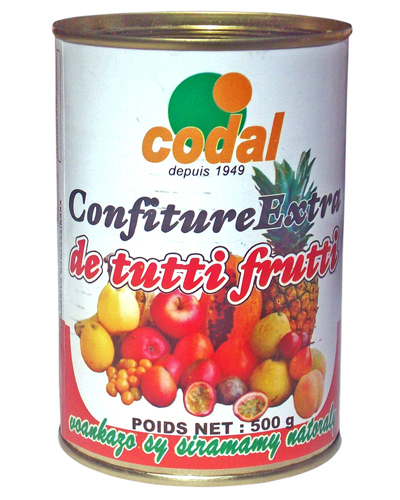
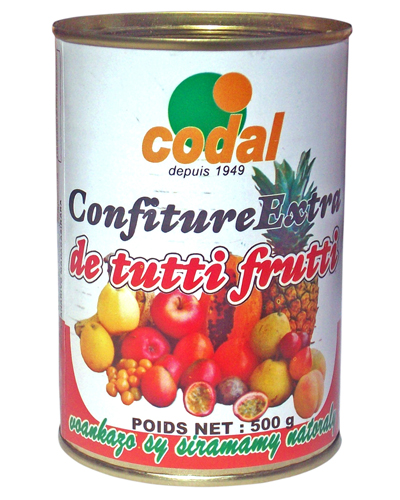
 When I was a child growing up in Madagascar, there was a jam factory not far from where we lived. Codal made the only local jam that we were aware of in the country, and in the 80s their canning technology was a rather out of date. The jam came in tins, and often you’d open it and find a ring of black iron-flavoured jam where it hadn’t sealed properly.
The sugar content was also very variable, depending on the price of sugar at the time. If it had been a bad season for sugar cane, it would be expensive and they would skimp on the recipe. Sometimes it hadn’t set and the jam would be really runny. My dad, being a jam enthusiast, used to buy it and re-boil it with extra sugar. He used to refer to Codal’s product not so much as jam, but as a ‘DIY jam kit’.
The company had a range – peach, apricot, strawberry, and a variety of alternative flavours depending on the season. It also had a wild card: tutti frutti. This was basically whatever was cheap on the market at the time. You might get mangoes, guava, pineapple. It was a magical mystery condiment.
I was reminded of this because as part of our shopping for the Live Below the Line challenge, we’ve ended up with a jar of ‘mixed fruit jam’. Shopping around across the various supermarkets, Lou found a jar of jam that retails for just 29p.
I’m not sure how it’s possible to sell jam that cheap. You pay more than that for an empty jar if you’re making your own.
As we try and live on £1 a day for food this week, one thing has struck me more than anything else: food is really cheap. Probably too cheap, considering our obesity levels and the amount we throw away.
When we first agreed to try feeding ourselves for £1 a day, I was optimistic. I used to have a food budget of £5 a week when I was a student. Then I started looking at how much we spend now, and the impact of a decade of inflation, and I wasn’t sure how we were going to do it. Once we started comparing prices and seeking out the cheapest options, I realised it wasn’t actually that hard after all.
Taking this challenge in an developed country, we have a huge headstart on those who have to live on £1 a day in a poor country.
We have an industrialised food system. Agriculture has been mechanised for almost a century, with tractors and combine harvesters drastically cutting the labour element of farming, keeping prices lower. Raising lifestock has been industrialised too. It comes at the expense of animal welfare, but it makes meat and eggs affordable in ways it has never been before.
On top of that we have a vast system of infrastructure around food, from silos and grain elevators, to warehouses and cold-stores, refrigerated containers, lorries and roads. We can move food fast and fresh, with minimum wastage. It means we can get a far greater range of foods to market, and in large quantities, without losing much along the way.
We also have supermarkets, responsible for the consumer end of that food infrastructure. Supermarkets have a major role to play in keeping food cheap. With so many stores, the big chains can get enormous economies of scale. Because they place such big orders, they have a lot of power over suppliers. They can drive a hard bargain with farmers and manufacturers, forcing prices lower for consumers.
There are also political factors keeping prices down. Both the US and the EU subsidise their agriculture at a cost of tens of billions a year. The former dates back to the 1930s, the latter to the post-war shortages of the 1950s. They have no place today and are a massive (and hypocritical) distortion to global food markets, but they’re politically very difficult to undo.
Food prices have risen for all of us recently. They will remain volatile for the foreseeable future, as the world population grows, the oil price fluctuates and climate change takes its toll. But right now, we enjoy amazingly cheap food here in Britain.
- PS: I am delighted to see that Codal is still going strong and still producing Tutti Frutti. The company has a considerable range of products and is an exporter of fine Malagasy foods.
 The Earthbound Report
I wonder if the supermarkets use their more expensive ranges to subsidise their budget ranges? It would be a way of getting the real bargain-hunters into the supermarket (so they can buy some more expensive items too, and to keep competitors at bay). In other words, if everyone bought Asda Smart Price, then would Asda still be able to sell those products so cheaply?
Definitely. The basics are often loss leaders, sometimes sold at less than cost price to get people into the store. Once you’re in, there are 101 different ways of making you buy things you didn’t come in for!