
The Climate Crisis film festival ran in November, and this week launched an online hub where you can watch 20 climate documentaries for £10. Some really good ones on there and I’ll be doing that myself. And as a reader of this blog, you can get yourself a 20% discount by clicking here and using the code GREENCHRISTMAS

Amazon is now the biggest corporate purchaser of renewable energy in the world. This does not make them good, it makes them fractionally less evil – but it’s a step in the right direction.
I hadn’t heard of ‘coral refuges’ before, but I was glad to hear that ocean currents can create pockets of cooler water that coral can flourish in, such as this one of the Kenyan coast.
David Powell is wise and funny and well worth reading on eco-anxiety in the latest issue of the New Economics Zine.
It’s always worth keeping an eye on what Drawdown are up to. Their latest report is called Farming our way out of the climate crisis and I’m going to try and make time for it this week.
LATEST POSTS
What we learned this week
With the arrival of smaller and cheaper options on the market, the average price paid for a new electric car is now cheaper than petrol cars in the UK, according to Autotrader. The total cost of ownership was already lower, and now the sticker price shouldn’t be a sticking point either. Beyond private cars and…
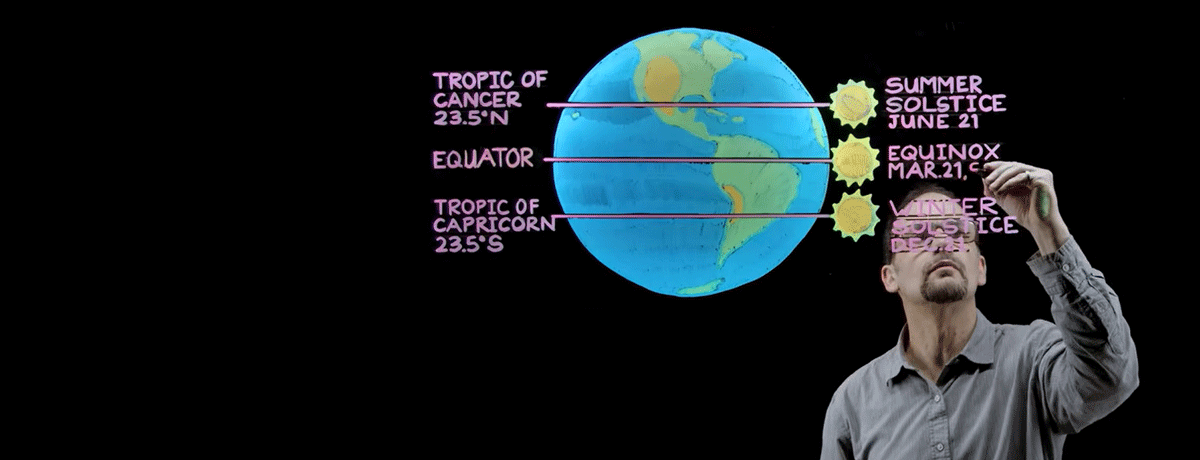
Orienting building for energy savings
I’ve been doing quite a lot of work around summer overheating recently, looking at how we adapt buildings for a warmer climate. For the day job that’s with schools, and I have a personal interest in it in homes as well. Our own house has a tendency to get too hot in the summer, and…
Trump’s accidental boost to the energy transition
One of the greatest spurs to environmental action was the series of oil shocks in the 1970s. As the Rapid Transition Alliance describe in a history of the era, it transformed the environmental movement from a focus on conservation to a focus on energy. Governments responded in all sorts of ways to the wake up…
Book review: Two Wheels Good, by Jody Rosen
There’s no shortage of histories of the bicycle out there, but this is a fun one. Published in 2023, Two Wheels Good brings the story of the bike right up to the modern day, with elements of travelogue and personal memoir, and a curiosity about the eccentric corners of the cycling world. The book covers…
Something went wrong. Please refresh the page and/or try again.
 The Earthbound Report
Thanks for highlighting the Kenyan coral refuge. I know we need far deeper concern, alarm even, over our corals, but it’s encouraging to know of signs of hope too. I was reminded of the discoveries of resilience in the Red Sea and off Australia, and other measures to protect/restore them:
https://phys.org/news/2020-12-coral-recovery-prolonged-heatwave.html
https://theconversation.com/meet-the-super-corals-that-can-handle-acid-heat-and-suffocation-122637
https://www.theguardian.com/environment/2020/oct/17/why-there-is-hope-that-the-worlds-coral-reefs-can-be-saved
[hoping this comes across as ‘interested interaction/reaction’ stimulated by your post, which is the intention here, not as ‘competitive reportage’]
Interested interaction noted! These stories are important, as it’s felt like the loss of coral reefs is almost inevitable. If that’s the only narrative we have, it risks becomes self-fulfilling.
yes I have a feeling that’s how things should work on other issues too. I feel we need to be conversing on how things will turn out both worse and better than we anticipate, but there’s always a path to hope. I’m glad that sites like yours are bringing this out