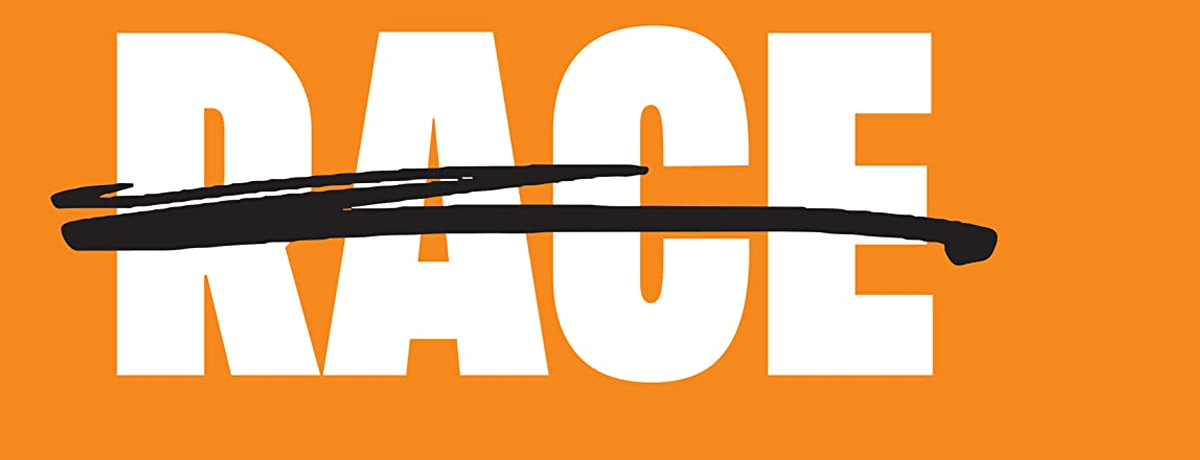

Having written a book about structural racism, I have a lot of conversations about the topic. One thing that has surprised me is how often people want to talk about Critical Race Theory (CRT). Sometimes they tell me they agree with what I’m saying, but they’re not so sure about this CRT business. Or they rebuke me for being taken in by it.
Which is odd. It’s strange that they’ve heard about CRT at all, as it’s an obscure and technical field of legal studies from the 1980s. What’s also odd is that when people starting talking about it, it’s immediately clear that their understanding of it is entirely different from mine.
I’m no expert, but I did do some background reading around CRT as part of my research a few years ago. I know enough to know that CRT isn’t what people seem to think it is. So how did it get on the radar? And how did the definition of it get so mangled along the way? There must be a story behind this.
Indeed there is. David Theo Goldberg, a South African professor of humanities at the University of California, explains it in his new book The War on Critical Race Theory. He has been working with CRT since the 1980s, and says that “until September 2020, almost only college law professors, social scientists, and humanists had paid even the vaguest attention to Critical Race Theory.”
What happened in September 2020 is that Donald Trump was watching Fox News, and saw an interview with a man called Christopher Rufo. Rufo was ranting about how CRT is a guiding ideology of the Marxist left that is destroying America, and it captured Trump’s imagination. Rufo was summoned to the White House, and three weeks later the president had signed an Executive Order against CRT, banning all government agencies from doing any kind of training on race or gender.
From here, things escalated. Lawmakers in 35 states followed suit and passed laws banning or restricting the teaching of CRT. Many of them ban entire indices of words associated with it, including ‘intersection’, ‘structural racism’ and ‘social justice’. It’s become a voting issue, with politicians vying to see who can be most anti-CRT.
Teachers and superintendants have lost their jobs over it, authors and academics blacklisted. Book banning is back, and running at higher rates than it did at the height of the McCarthy era. There are campaigns to close down public libraries entirely to protect children’s minds from bad ideas. A group in Nevada are lobbying to make teachers wear body cameras, like police officers do, to make sure they don’t talk about race or privilege in school. The governor of Wisconsin set up a tipline to encourage people to report teachers with CRT sympathies. At his rallies, Trump has called for people to “lay down their very lives” to protect the country from CRT.
In other words, it all went a bit mad. People are terrified and furious about something they’ve only just heard about, even though it’s been around for 40 years and isn’t what they think it is. And this is entirely intentional, says Goldberg. Rufo is an activist in US thinktank circles, and his work opposing CRT was funded by the Heritage Foundation, the Manhattan Institute and others. As Goldberg reads it, these organisations hatched the idea of setting up CRT as catch-all term for any and all talk of racial justice. Associate it with anything you don’t like, foster enough anger about it, and it can halt all forms of progressive action on racial inequality.
That sounds like a conspiracy, except that Rufo has openly boasted about his intentions: drive CRT into the public conversation as a toxic political term. “The goal is to have the public read something crazy in the newspaper and immediately think ‘critical race theory’,” he wrote on Twitter. “We have decodified the term and will recodify it to annex the entire range of political constructions that are unpopular with Americans.”
It’s working. People think CRT is Marxist, because Rufo, Trump and the Republicans and the thinktanks keep saying it is. It isn’t, but nobody bothers to check. They say it teaches children to hate themselves, that it divides everyone into oppressor or oppressed, and that it says all white people are racist. They are “attacking a phantom” says Goldberg, who has been writing about CRT for decades. “Simple fact-checking shows that virtually every claim about CRT is outright false, twisted to portray its least agreeable interpretation, or at best half-true – which is, by implication, also to say half-lie.”
There’s a context for this, the book argues. America was 80% white in 1980, is now somewhere nearer 60%, and whites will be a minority by 2050. It’s a time of demographic change, and persistent inequalities in power and wealth are stark. For those who have always had an unfair advantage, equality is experienced as loss of privilege. That leaves them feeling uncertain, and vulnerable to extremist explanations – even entirely fabricated ones.
And make no mistake – the CRT outrage is a fabrication. “Rufo could care less what CRT in fact stands for,” writes Goldberg. “The goal is to set fire to the shift in American politics regarding race and racism, the pace of which had quickened significantly following the George Floyd murder in May 2020.”
The War on Critical Race Theory is a useful explainer for all of this. It describes the basic tenets of Critical Race theory as expounded by its original authors, and contrasts it with what right-wing commentators say it is today. It explains the network of organisations and funders behind the campaign to elevate and discredit social justice work through the straw man of CRT. It reports on what is being done in the name of defending liberty against CRT, and what is being lost along the way.
It will be most relevant to American audiences, but we should be paying attention in the UK too. Britain is not America and the race debate is very different here. Nevertheless, all the warped conversations I’ve had about CRT have been here, often centering on colonialism and empire rather than slavery and segregation. I’ve read articles and books by British authors repeating Trumpian lies for a British context. It’s seeped into the church, where there’s a strange conflation of theology and right-wing politics going on. And the thinking of the Heritage Foundation and friends is crossing the channel – including the recent National Conservatism conference, which drew Conservative MPs and cabinet ministers.
I suppose the most hysterical anti-CRT folks are more likely to ban Goldberg’s book than read it. But for those thinking people that may have heard rumours about the evils of CRT and aren’t sure what to think, it’s well worth picking up.
- The War on Critical Race Theory is available from Earthbound Books UK and US.
 The Earthbound Report
Appears to me almost everyone has a different definition of CRT. Even among those promoting its teaching. But, we can agree on the definition of anything else, so disagreeing on this theory should not be surprising.
But, we can’t agree on anything else . . .
The problem is that there really haven’t been many people promoting CRT – it’s an obsure and academic field in legal studies! The most important breakthroughs were made in the 80s, and much work has happened since then on top of it, some of it improving it or challenging it. So what is there to promote?
Besides, some of the people who are regularly cited as being promoters of CRT are no such thing. Robin DiAngelo, for example, is promoting almost the opposite of CRT because she’s interested in personal actions rather than structural ones.
The point is that there is an agreed definition of CRT and has been for 35 years. It has now been hijacked and weaponised, and is now useless – like the word ‘woke’. It cannot be used without sowing division and confusion.
Not sure this is a complete view of what went on.
James Lindsey and Helen Puckrose’s book ‘Critical Theories’ was published in May 2020 examining the rise of the ideology now called ‘Critical Race Thoery’. Many people had been noticing the ideas taking root across academia. It has been noticed that these ideas resisted being named so their proponents could plausibly deny crazy stuff like ‘Defund the Police’ while engaging in Mote & Bailey tatics with supporters. Names like ‘Successor ideology’ have been floating around bigot a while by those trying to get a handle on it.
Chris Rufo is one of the most consequential campaigners for years. He saw that giving a name to the basket of ideas would allow the public to discuss it. He said what he was going to do and he did it. Similarly he spent 2021 saying what he was going to do to raise the issue of trans ideology in public life and he did that successfully too. I was following him from early 2020 and he’s a bit if a hero..
Complaining that an opponent has successfully named the thing you support is annoying but any time you use neo-liberalism or tickle down as a pejorative just think of this as karma.
“ Names like ‘Successor ideology’ have been floating around quite a while by those trying to get a handle on it.” Damn predictive text
I understand the idea of successor ideology and the need to name something. There are two problems here though. One is that Critical Race Theory was already taken. It’s been around for decades. You can’t just pick a name from history and redefine it to include all the things you don’t like – which is what Rufo has decided to do. (And yes, I understand that weaponising a term happens on all sides. I don’t use the word neoliberalism for precisely that reason, so don’t talk about karma to me.)
The other problem is that naming a ‘basket of ideas’ can be a dangerous idea. It lumps everything together, tars it all with the same brush – pick your metaphor. Thanks to Rufo and friends, genuine attempts to honestly redress longstanding racial inequalities are now insepararable from the radical ‘defund’ end of the spectrum. It’s all one thing now in the public imagination, and can be dismissed together. This is of course how politics often works – generalise, polarise, push everything into simple categories of us and them, left and right, evil and good. It’s also why stuff doesn’t get fixed, and in the hands of people like Trump and DeSantis, it can lead to some very dark places indeed.
Rufo has unleashed a wave of book banning, surveillance of teachers and policing of thought – but he’s a hero of yours. That’s troubling.
He’s a hero of mine because almost single handedly he took on two schools of thought in America which have very dangerous aspects (holding power higher than truth, indeed denying the existence a real truth, seeking to racialise & ‘queer’ society, attacking the tenets of liberal society such a neutral law and equality based on equal worth) and has succeeded in pushing back.
He’s not perfect but he’s better than the world CRT would create.
The fabrication is that the anti-CRT backlash is a fabrication. This ideology sprang on a great many people on 2020 and as they become aware of its harmful side it is legitimate to push back. Against an ideology that doesn’t hold truth in high regard that push back has to be firm, especially in the American context.
And I would say that if the proponents of CRT object to it being included with nutty ideas like Defund the police & prison abolition they should have distanced themselves at the time, not waited until it was clearly very unpopular.
You’ve swallowed Rufo’s agenda hook line and sinker – his goal is to lump everything together and bin it all in one go. There’s a multitude of voices in any healthy debate. Rufo deliberately contracts everything into his own definition of CRT, calls it communist for the sole purpose of scaring people, and stirs up the necessary hysteria to get it all binned together. It’s entirely right to challenge extreme ideas, but by making it impossible to tell them apart from the sensible ones, Rufo has set back racial justice by years in some communities. But hey, you’re a white guy and you’re not in America, what do you care?
By their fruit you will know them, as Jesus said about false prophets – and the outcomes from Rufo’s work is a wave of book banning, surveillance of teachers and policing of thought. This isn’t what you stand for, given your previous advocacy of free markets, freedom of speech, or liberty of any kind. So why the double standards when it comes to race?
Unfortunately the policing of thought was already underway from the other side, otherwise no one would have lost their jobs for saying ‘All lives matter’.
I said I didn’t think he was perfect. But the situation in America is so polarised, that activists in education & the public sector so vociferous that his more forceful approach may be necessary to bring the two sides to the conciliation that rather than seeking to impose themselves on each other compromise might be necessary.
Frankly the intolerance from Rufo is less than the intolerance of Critical Race Theorists or the rest of the Successor ideology such as Queer Theory (which is Rufo main focus now and I notice you ignore). Critical Theorists are absolutely no friends of free markets and totally against free speech and liberty so choosing Rufo as the lesser of two evils is a slam dunk.
I think you will find it was the massive over-reach of 2020 by Critical Race Theory supporters that set back race relations. The massive rise in violent deaths among Black Americans because of the ‘Defund the Police’ police pullback., or the sudden hectoring of half of America denouncing their ‘Whiteness’. The subtle implication that anyone who raises objections is racist (I saw what you did). Everything from CRT breeds resentment on both sides rather than bring people together. That support for BLM is falling in the States is not a sign of racism but of it’s exposure as the ideologically racist grift it always was.
While CRT may not be communist in the old sense it is Marxian if not Marxist.
As to challenging the more extreme ideas, there seemed to be have been radio silence from supporters such as yourself until people like Rufo created a serious challenge.
So Kimberly Crenshaw or Chris Rufo, I choose Rufo.
More fool you.
I don’t have to pretend it’s a plot by my lying enemies to justify why my side is losing support rather than mistaken action & belief.
My side can mess it up all on their own.
Did you even read the review? It’s not a plot – Rufo has publicly stated what he intends, and you have drunk his kool-aid. And it goes down easy for someone like you or me, because we’re not the ones who are disadvantaged if nothing changes. That’s just a statement of fact. (Same on LGBTQ issues, which I haven’t mentioned because this is a book review about CRT.) Opposing action on social justice costs us nothing. That doesn’t mean we have nothing to say, but it does mean we should be open to listening, and draw our conclusions carefully.
Most importantly, it isn’t about taking sides. I don’t consider myself to have a side, because this isn’t a debate with simple for or against positions. There are thousands of voices and opinions, some well argued and eminently sensible, some extreme or ill-informed. If someone or something is being left behind, I want to hear the best policies for how that can be redressed, whether the inequality is based in race, gender, class, or geography. Some of those issues are highly charged, some aren’t (like marginalised coastal communities, for example), but they’re all different dimensions of the same thing and should be heard.
Instead of constructive debate, everything you’ve written so far tells me that you’ve accepted the definition of CRT that your great hero Rufo has given you without question. Your comments ably demonstrate that you don’t know what CRT is, only what he says it is, and so you’ve basically proved Goldberg’s point.
Which is why I say more fool you.