
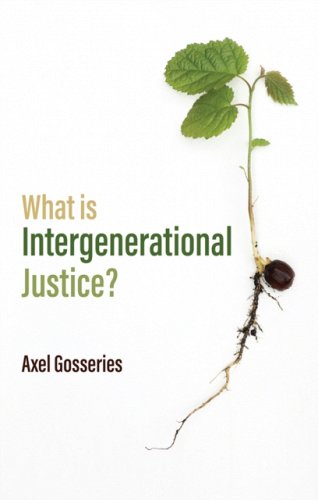
I think a good marker of a successful society is whether or not it is able to think beyond itself in space and time. Arrogant, paranoid or failing societies have no room for anyone but themselves, concerned only with immediate needs, whether real or imagined.
Successful societies can look further, even when times are hard, and work for the benefit of those who come after them. American indigenous traditions speak of decision-making with seven generations in mind. The Bible talks about stewardship for future generations, and how good decisions can echo through the ages. There’s the simple folk wisdom of leaving things better than you found them.
It feels like we’ve lost these sorts of perspectives. Underfunded schools, unsustainable pension funding, and environmental decline are just three examples of the poorer future we are creating, and we need to rediscover ways of talking about intergenerational justice.
Axel Gosseries’ book attempts to outline the philosophical questions around intergenerational justice, defining terms and addressing some key problems. What is a generation anyway? What do we owe the future? What happens when generations don’t overlap, and who speaks for the future? Is it even fair to think about our obligations to people who don’t exist yet, and are therefore only theoretical?
These are questions that challenge our conventional ethics in some complicated ways, and that becomes obvious pretty quickly in the book. Chapter one disappears down a rabbit-hole called ‘the non-identity problem’, which I won’t attempt to explain because I’ll get it wrong. It’s exactly the kind of academic conundrum that gives philosophy a bad name, and Gosseries knows this. “Unfamiliar readers might feel cheated and react with disbelief or even irritation” at this long discussion of the ‘problem’, he warns. Correct.
Unfortunately these sorts of observations on the frustrations of the text recur throughout the book: “Some readers may be concerned about avoiding philosophical hairsplitting”. “Other aspects of the book may possibly have puzzled the readers.” “This conclusion may be disappointing.” Obviously the author hopes to convince readers that these discussions matter, but there’s a fine line between illuminating complications and introducing them, and I honestly can’t tell how many of these debates are useful and how many are theoretical distractions.
That doesn’t make this a bad book. It makes it a book for a specific audience, despite the statement in the introduction that the book is “intended for philosophers and non-philosophers alike”. If you’re interested in the philosophical approach to the topic and want to think about it in those terms, it will be a different reading experience. For me it was more a matter of gleaning useful ideas around the edges, and I’d have liked less conceptual discussion and more practical examples. Still, I feel no compulsion to finish books, and I found enough insights and thoughtful questions to keep me reading to the end.
Of course, conceptual secular philosophy is only one way of thinking about these issues. I found it interesting to contrast it with the Christian tradition, which talks more about inheritance than obligation. It’s less concerned with rights and who ‘owes’ what to whom, and asks what kind of legacy we leave. We can be a blessing or a curse to the future, and how we treat each other, how we treat the land itself, can lock in prosperity or hardship for our children’s children. I suspect the real benefit of reading What is Intergenerational Justice? will the dialogue between traditions as I mull these things over.
- What is Intergenerational Justice? is available from Earthbound Books UK
 The Earthbound Report