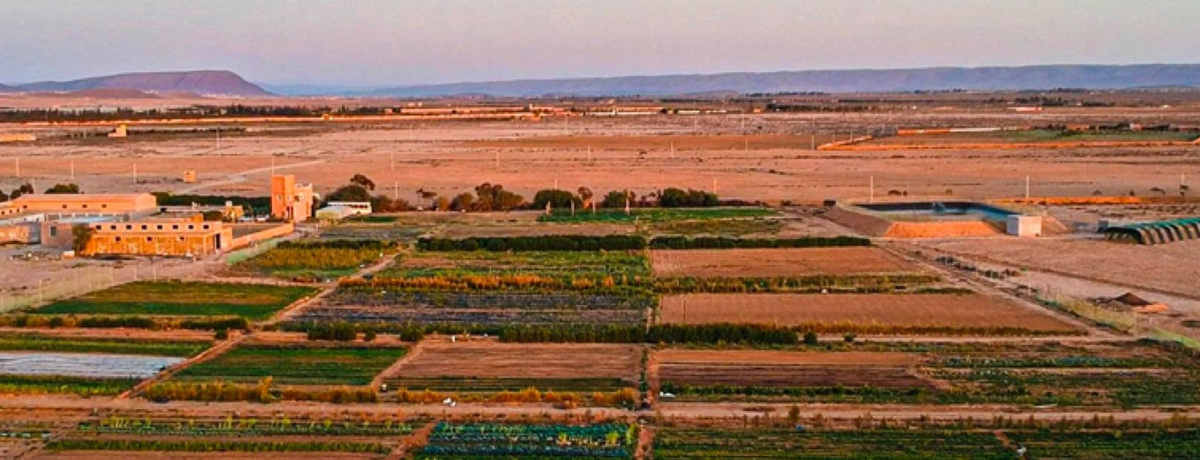
The oasis is an evocative geological feature – a life-saving island of greenery in an otherwise barren landscape. They have provided stop-over points on trade routes, refuge for political outcasts, and today an estimated 150 million people live in oases.
The reason that an oasis can sustain life in the desert is of course the presence of water. If there’s water, there can be plants, and if there are plants then there can be animals. Including people. Oases occur naturally where there are springs, but what if you could create them? If you could bring water into the desert, could you reclaim it for biodiversity, for trees or for agriculture?
Sand to Green is a company that has studied this very question and is putting it into practice in Morocco. They have installed a solar array, and used it to pump up salty groundwater from deep underneath the desert. It’s then run through a solar powered desalination plant in a container module, from a company called Osmosun. The clean water is then used to irrigate a regenerative agriculture project.
Water evaporates quickly in hot conditions, so it is piped to plants through a drip irrigation system. This delivers it straight to the roots in small quantities, so that it can be taken up and none goes to waste. Sand to Green also use biochar to hold moisture in the ground, so that soil can begin to form.
So far they have a 38 hectare plantation, growing planted selected for the conditions. Trees such as figs, pomegranate and carob are taking root, with plans to produce herbs, nuts and dried fruits commercially. Alongside these commodities, the farm will have a second income stream in the form of carbon credits, which makes the whole project viable.
Inspired by the ecology of the oasis, Sand to Green are reclaiming a patch of Moroccan desert for agriculture. They’re not the only ones proving it’s possible. Israel has perfected techniques for farming in the desert. Sundrop showed how solar and desalination can be commercially scaled up in Australia. Norway and Jordan collaborated on the Sahara Forest Project. China has discovered that solar farms in the desert can be designed to manage water and create soil, doubling up on renewable energy and land restoration.
Perhaps it’s too early to tell if these projects can become commonplace enough to really make a dent in the world’s deserts. But they do suggest that the wilderness isn’t just somewhere to pass through on the way to the nice bits. Desertification can be reversed. You can make your own oasis.
 The Earthbound Report
See – there IS some potential for good from carbon credits!!! ; ) Thank you!