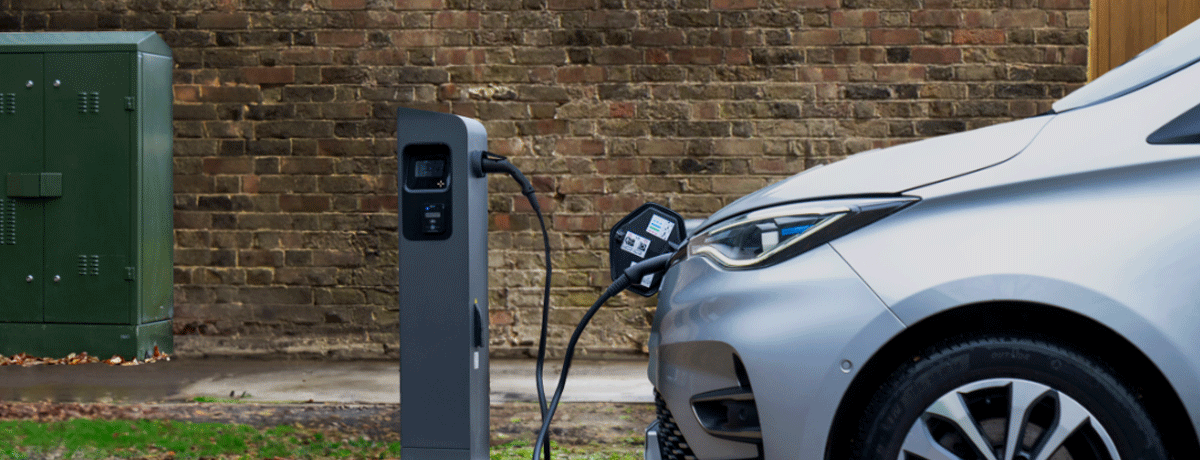
Last week I charged the electric car in four different countries. All of the chargers worked, and I used the same Electroverse card on all of them. It’s the first time we’ve taken the car outside the UK and it was entirely painless.
It was not always like this. Though most charging happens at home, early adopters of electric vehicles had to put up with a few frustrations on longer journeys. Charging infrastructure was patchy across England and there were dozens of different suppliers. Most of them needed a membership card or a RFID tag or an app. This wasn’t the case in Scotland, where the government built a national network of chargers, and my north-dwelling brother grumbled bitterly when he had to cross the border and find somewhere to plug in.
That began to change a few years ago. A handful of larger companies rose to the top of a crowded market, and their networks expanded. We found out which companies were more reliable and which ones to avoid. I look out for Instavolt, MFG or Gridserve chargers. If it’s PodPoint or BP Pulse, there’s a 50/50 chance it won’t be working when you get there. Some networks have prioritised growth over maintenance, and leave chargers broken for months. (Special shout-out to BP Pulse here, as I visited a school yesterday that had their chargers installed in the car park in 2020 and they have never worked.)
The overall network has improved. There are more chargers, more high capacity chargers, and they are easier to use. It took a long time for operators to note that people would prefer to pay with their bank cards than to join a club or fiddle about with an app, but that’s pretty much normal now.
Following the growing number of installed chargers, and then the winnowing out of under-performing operators, a third step in convenience is now underway. That’s the consolidation of charge networks into user-friendly universal services. We’ve had the Zap-Map app for a while, which made it easy to find chargers, with live updates on whether they were in use or not. The big step forward is master networks such as Octopus’s Electroverse, which has got over a thousand different operators and almost a million chargers all available on one charge card.
That’s what we used on our travels last week, charging the car in England, France, Belgium and the Netherlands on one service. We get a discount as Octopus customers, and it adds the cost to our household energy bill. There are alternatives. Ovo Charge is one, set up for their home energy customers but open to anyone. Some car companies run their own, such as Kia Charge or Volkswagen’s WeCharge.
There’s more to do. It was almost laughably easy to re-charge in the Netherlands, blessed as it is with more charge points per capita than anywhere else on earth. There’s more to do in the UK, which still has black spots and charging deserts. It’s still possible to find motorway service stations with no working charge points, which is bizarre. But if it’s the charge network that’s been holding you back from getting an electric car, it might be worth looking again.
 The Earthbound Report
Interesting we took the Leaf to ROI but didn’t use the public charging network. This is poor in both NI and the north part of ROI though.
Zapmap I find very inaccurate. It gets the max speed, cost, location or even type of chargers wrong very very frequently. It misses some groups of chargers off completely (Gridserve on certain places on the M6 and BP pulse at Harthill on M8) I use it as an initial look but also plugshare and chargefinder. No app or map such as google maps shows them all.
I think your brother is being very optimistic about Chargeplace Scotland. Their chargers are frequently ancient and don’t work. We had a journey where 3 in row didn’t work (though each time I phoned them they swore the next one down the road would). The 4th that did they thought was behind a barrier at a port – it wasn’t fortunately. The problem is the local authorities put their chargers in and are supposed to maintain them – Chargeplace simply do the day to day admin. There’s one near us that allows free charging though.
BP pulse – truly dreadful but if you can get them to accept your payment accepted they work beautifully. By law all chargers over 8kW should accept a bank or credit card. I could be very cynical and say that they want you download their app which unusually you have to preload with money. People say this always works.
Electroverse – brilliant! Never got a discount with it though. Its not accepted by BP pulse (surprise surprise) or Gridserve.
Gridserve are great. You rock up pay charge and they just work. They seem to take their customer service pretty seriously. If you use the app you get a bit of a discount and it tells you how fast your charging on your phone.
All the above being said love the Leaf and never run out of charge yet.
You’re right about Scotland, and my brother’s enthusiasm for it was indeed a few years ago now. Public charging networks were really helpful in getting EVs into the mainstream, but have been overtaken by commercial operators at this point.
Until recently I was double-checking Zap-Map to make sure there weren’t any chargers I’d missed. The lease is up on the Leaf and we’ve got a Kia that goes considerably further now, so I’m a bit more relaxed about it and Electroverse is working out fine.
Perhaps the most interesting thing about Electroverse is their plunge pricing, though I’ve never had cause to claim it personally. They look ahead at the weather, and if there’s going to be a projected surplus of renewable energy, they’ll offer a discount to encourage people to charge during those hours. There’s one today in fact, 20% off with certain operators because it’s windy. That gives Electroverse a role in balancing the grid, and it passes cheap renewable energy on to users in a way that is very rarely visible.
Yes I’ve never managed to use the plunge pricing yet. Tesla does this even better but even if I could use their chargers I wouldn’t. Chargeplace were all free until just before we bought the Leaf and have jacked their prices up a lot since although they can still be cheaper than the more commercial competition. Assume you had a Gen 1 Leaf?