We’ve had a heatwave in the UK recently. Then it moved across the continent, setting new records along the way – the hottest ever month of June in Britain, peaks as high as 46C in Spain and Portugal.
Like many houses in the UK, ours overheats. It’s almost a hundred years old and was built for a different time. The hottest temperature of the year in 1928 was 32.2C. Two decades would pass before the house saw temperatures above 35. The hottest day of the year has been over 35 for seven of the last ten years.
Two things have made it worse. One is that our neighbour cut down the tree that grew out the front of our terraced houses. It was dropping leaves on her car, apparently. Those same leaves were also shading both our houses during long summer afternoons. I suspect she regrets it now, but it will take 50 years to put back.
The second thing is that we have insulated our house really well. Insulation is designed to keep heat in the house, so this is a good thing in winter and less useful in summer. The external wall cladding does slow down overheating, but once it’s in the house it doesn’t escape easily. So we need some extra steps to prevent it overheating in the first place, especially by shading the windows.
Over the years I’ve experimented with various ways to create shade. I’ve made my own lightweight brise-soleils held in place with velcro. I’ve made elasticated fabric screens that wrap around the outside of the glass. Some of these have been more succesful than others. At one point I had to retrieve my brise-soleil from down the road, as the wind whipped it away. I attempted to grow a living wall of bamboo that I could roll in front of the bay window, but I bought the wrong variety and it never grew tall enough.
Here are some that I’m using this year, just in case they’re useful to anyone.
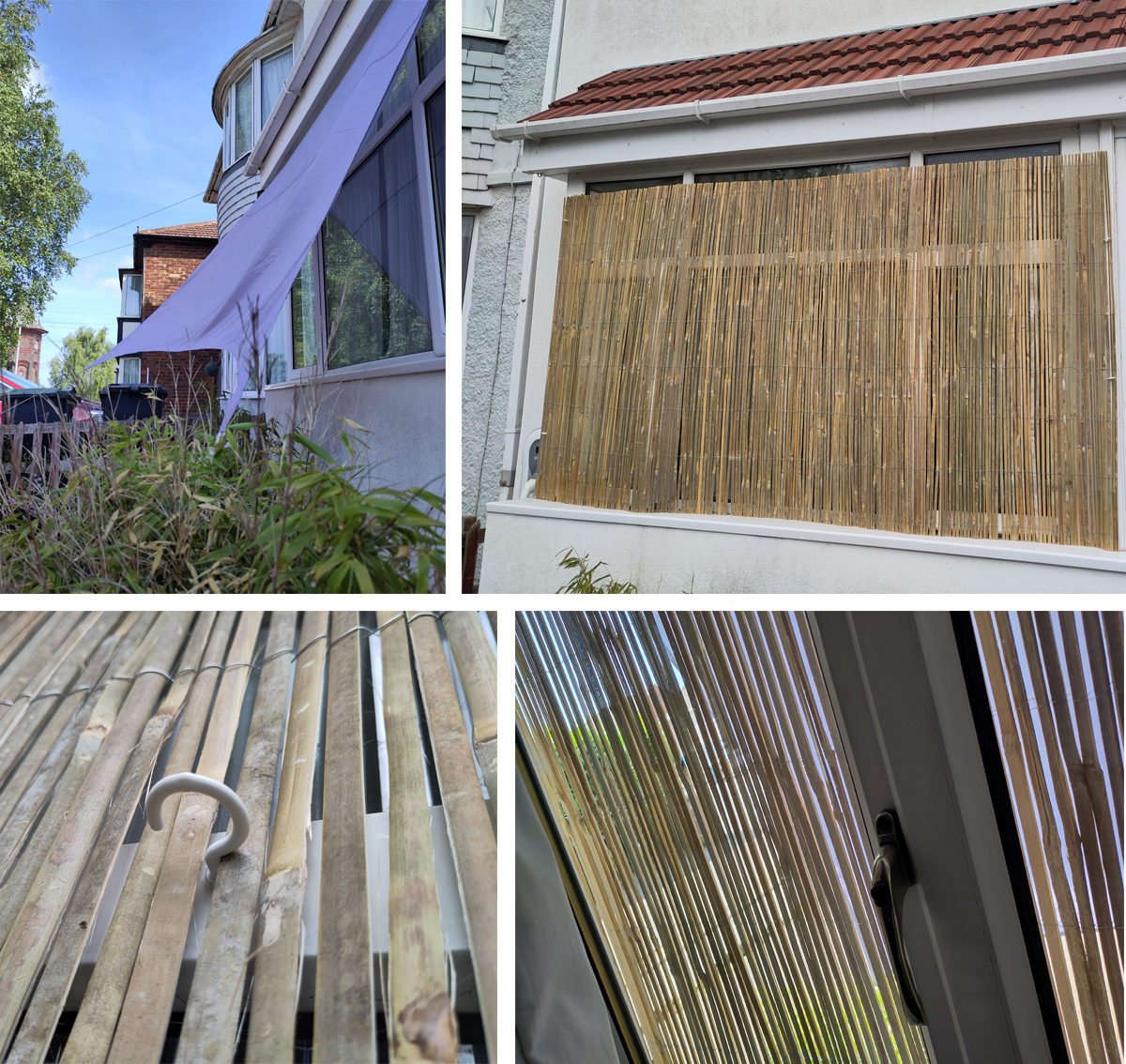
Priority number one is the bay window at the front of the house. Lots of glass, and in full sun from around 11 in the morning until the sun goes down. I bought a shade sail off the internet, and it’s a cheap and quick solution for shading windows. I’ve installed brackets for it at the top so it can be easily hooked on, and it’s tied to the fence at the bottom.
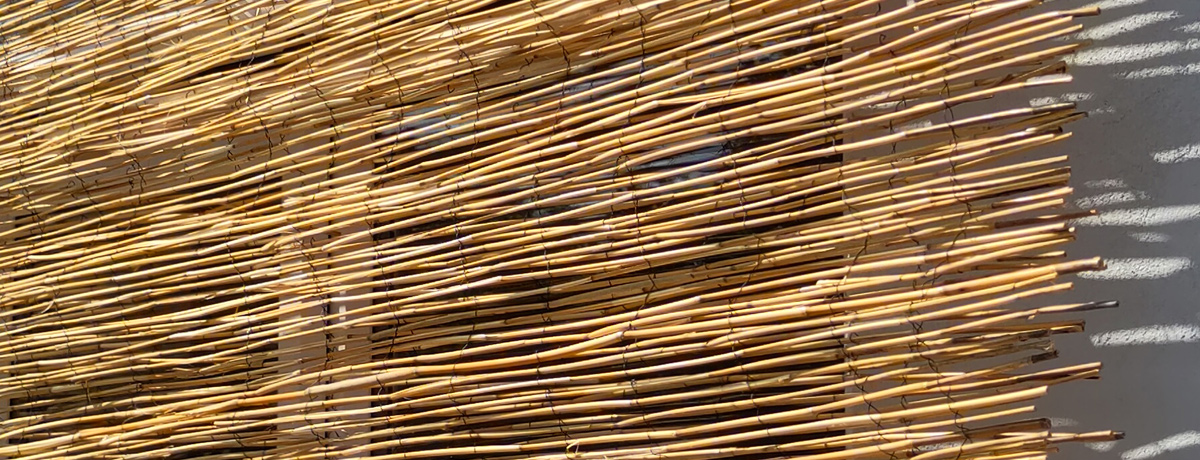
It’s not the most attractive option however, and the light grey fabric still lets a certain amount of heat through, so this year I’ve tried out a bamboo screen. These are designed for use in gardens, but I think it works pretty well here too. It’s attached to the window with cup hooks, which I twist to the vertical and push between the slats, and then twist back to hold it in place. There’s enough slack in this that I can still open the windows inside. I’ve not seen anyone else do this, but it’s very easy and effective and I can install it or remove it in under a minute.
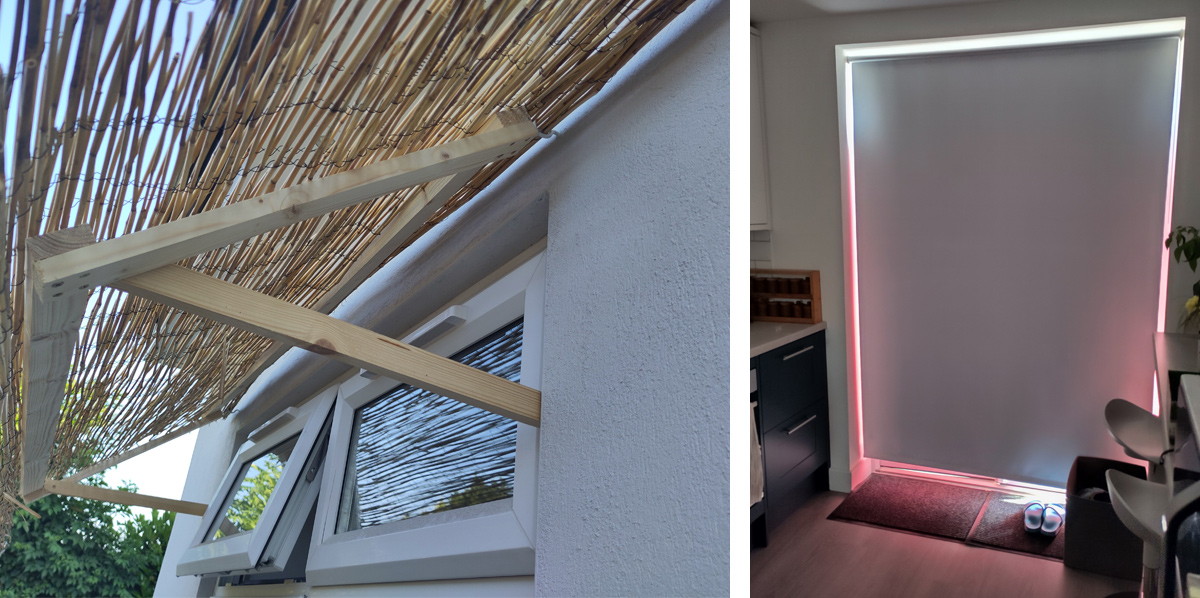
The back of the house gets the sun in the morning, which can still be pretty intense during a heatwave. The back door has a big internal roller blind that we drop over the glass. This isn’t as effective as external shading, but it’s good enough.
For the windows of the office I have an awning of my own simple design. It’s a wooden frame that hangs on two hooks above the window. The two lower wooden sections can brace the frame to create an awning, or they can be tucked in to drop the whole thing over the window. I have a reed screen on there at the moment, but it could be fabric or canvas. I made this from scrap wood left over from the build, and so it cost under £20. When the temperature drops, it takes ten seconds to unhook the frame and stash it in the shed until it’s needed again.
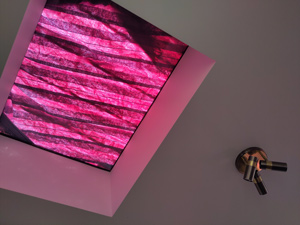
Finally, and most basically, the little extension at the back of the house has a skylight which brings natural light into the house during winter months. It was making the kitchen too hot last week, so I leaned out of my daughter’s bedroom window and threw a blanket over it. It’s heavy enough that it doesn’t blow around, and I retrieve it with a litter-picker once the sun moves around.
I don’t consider any of these to be permanent solutions to overheating. They’re temporary measures until we can fit some external shuttering, awnings or reflective glass. Since heatwaves are going to be more likely in future, adding shade structures is a form of climate adaptation and an important part of making our house fit for our changing times.
So I’m not done experimenting, and now that we’ve finished our building project I’ll be looking at some lasting shade solutions for next summer. In the meantime, these are some simple defences for heatwaves.
- See more of this sort of thing at Shade the UK.
 The Earthbound Report
Some interesting contraptions and experiments to shade your house, Jeremy! Which one has been the most effective so far?
Probably the bamboo slats at the front. They’re chunky enough to block plenty of heat, but still allow light through and views outside. Quite pleased with that one!