Here’s a map that I enjoyed from the latest Our World in Data newsletter. It shows the leading source of electricity in each country. It’s a fascinating geopolitical snapshot, telling us a lot about who has access to cheap coal, gas or oil. There are lots of little stories here, adding up to one big one.
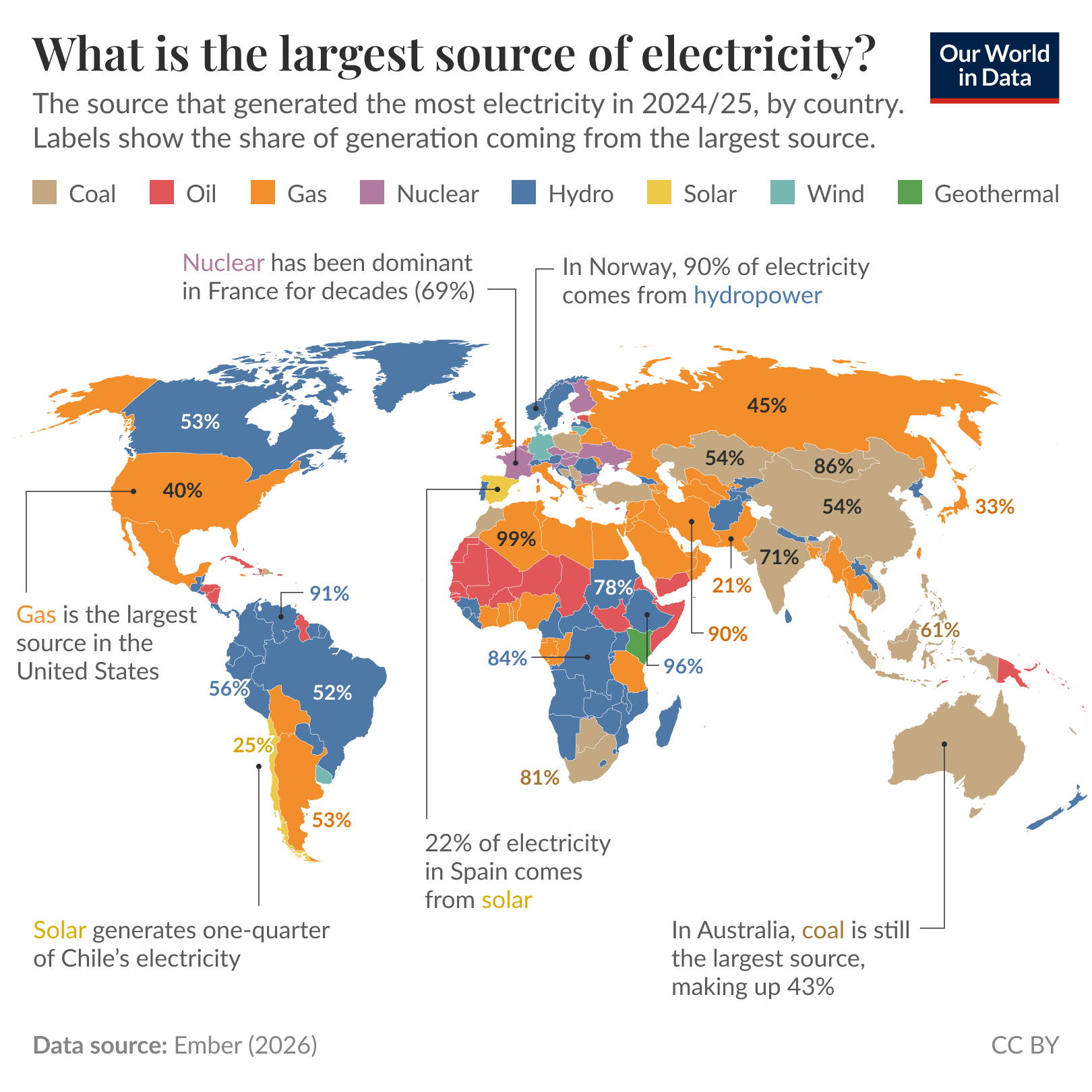
The big story is of course the global transition to clean electricity. If we were able to fast-forward, we’d be able to watch the colours change. Brown and red would blink out as countries move away from burning coal and oil for electricity. Some of them will switch to gas instead, so the orange areas of the map will shift and then erode. More and more yellow and teal will appear as renewable energy accelerates. The UK is likely to be wind-powered teal the next time this image is compliled. Large parts of the map, especially in the global south, will turn yellow.
We have forerunners already, and this is where we get the smaller individual stories. Take Lithuania, which had historically run on nuclear power. When it closed its aging Soviet plant in 2009, it switched almost wholesale to gas. That’s proven to be a major liability, and Lithuania has led the way in reducing Europe’s damaging dependence on Russian gas. It built wind turbines and solar power, and in 2022 became the first EU country to stop buying gas from Russia.
Uruguay is another country to flip colours recently. Like much of South America it has been largely hydro-powered, but is experiencing more frequent periods of drought due to climate change. When this happens they have to turn to more expensive energy imports, and so wind power is a form of climate adaptation in Uruguay. It’s an unusual example of a country transitioning from one form of low carbon energy to another.
Chile is also diversifying its energy mix to make it more resilient to droughts, and in their case it is solar that dominates, with hydropower providing the baseload.
Another country in yellow on the map is Spain, although it has very nearly equal amounts of wind, nuclear and gas. True solar states will emerge, with Pakistan moving fastest towards it. From less than 1% a decade ago, solar power has grown to 19% in record time. It’s overtaken coal as a power source and hydropower and gas are next.
Pakistan has been hailed as the fastest solar transition in the world and I’ve written about that myself. There’s another country with a less noted but similarly steep upward trajectory. That’s Hungary. It had ticked along with Russian gas, oil and nuclear fuel during the Orban rule. It is now building solar at a formidable rate, with solar power rising from almost nothing to 27% of energy generation in ten years. Not everyone will match that pace, but it shows how fast things can change when a solar boom takes off. Looking at the trend curves, it’s likely that even big coal users like Australia or Turkey will be yellow on this map in ten years’ time.
There are many more such stories. There will also be stories of laggards and obstruction, places where cheap fossil fuels delay the rise of renewable energy or where grid infrastructure fails. Other energy stories are in play as well as renewable energy, such as gas in Africa. Overall however, a huge shift is underway, another industrial revolution in how we generate energy.


Well written and informative. Bookmarked for future reference.