If you asked me to name some forested countries, I’d think of Canada and Russia, Scandinavia, Brazil. If I had to guess which country removes the most carbon from the atmosphere through its forests, I’d probably name one of them. And I’d be wrong.
Carbon Brief recently published an article on why global land use emissions are falling. Among the interesting facts therein is this one: the country that leads the world in carbon removal through forestry is China.
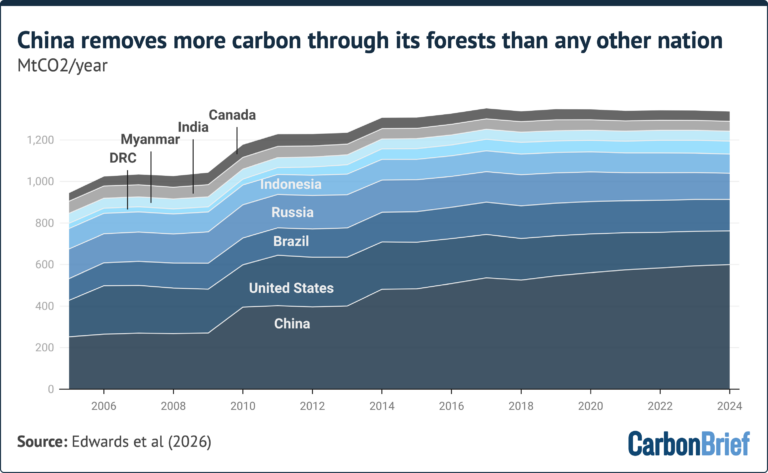
China doesn’t have the most forest coverage, either in land area or in percentage of tree cover. Finland’s forests cover almost three quarters of the country, versus China’s 25%. For size, Brazil, Russia, the United States and Canada all have more square miles of forest. The reason that China pulls in more carbon is that its forest are growing.
That wasn’t the case hundred years ago, with agriculture and the timber industry pushing China’s forests to a historic low by the middle of the last century. This had consequences, including soil erosion, drought, creeping desertification and sandstorms. A series of government programmes were launched to reverse the damage. The most famous is the Three-North Shelterbelt, often called the Great Green Wall, which aims to contain the Gobi Desert. Another project was Grain for Green, which paid farmers to turn some of their crop land back into forest in order to preserve soil integrity.
As this overview describes, some of these schemes weren’t initially successful or had unintended consquences. Projects that relied on monocultures of fast-growing species such as larch or eucalyptus found their quick wins came at the expense of local biodiversity. Over time the guidance has been updated to favour native trees and natural regrowth over tree planting targets. Lessons were learned in stakeholder participation and using local knowledge, or in unlocking co-benefits to use forestry to stop landslides or restore water supplies. Projects are now having to incorporate climate resilience into their planning.
These land restoration programmes were carried out on a scale unmatched anywhere else on the planet. Tree cover has risen from around 12% in the 1970s to 25% today, a startling recovery in the course of a single lifetime. There have been some remarkable regional successes tucked beneath those national statistics, like the Taklamakan Desert. Scientists using satellite data confirmed recently that after millions of years as a sandy desert, it is now a carbon sink.
Young trees pull in more carbon as they grow, which is why China’s massive re-forestation effort has a more positive effect on emissions than some larger mature forests elsewhere. (Those standing forests are storing a lot more carbon, so it isn’t a matter of one being superior to the other.) Restoring degraded forests is also quicker than growing new ones from scratch, which also helps to account for China’s outsized contribution here.
Nobody else is going to have the scale of impact, both positive and negative, on the climate that China has. But we can learn from their successes. As the Rapid Transition Alliance explain, China has proved that land and forest restoration can be done at pace, in ways that include local populations and that don’t hold back development. Plenty of other places could run with this – including the UK.
My home country of England has just 10% forested land, where China was a generation ago. Why shouldn’t that be 25% by the time my children reach retirement age?


Great and revealing read. In the UK the woodland trust has targets to plant trees in a belt across the north of england. I’ll have to look up their targets! Thanks to @kenthinksaloud for sharing your post!
And nothing to do with ridiculous claims about unscalable Direct Air Capture!
I’m not surprised China leads in this: they’re also motivated by the need to push back the creeping desertification and the annual, previously-worsening, dust and sand storms in their northern cities.
They also treat money and ‘investment’ differently to our supposedly superior western capitalist economies, although we like to think that they’ve moved on from their central-planning models. Yes, to some extent, in some aspects, they’re thoroughly ‘marketised’; but the government still commands (or ‘guides’) and spends, in ways our free-market countries don’t; with a much longer-term view.
That said, they’re likely to be in trouble with water shortages in their northern plains, as the Himalayan glaciers fail…