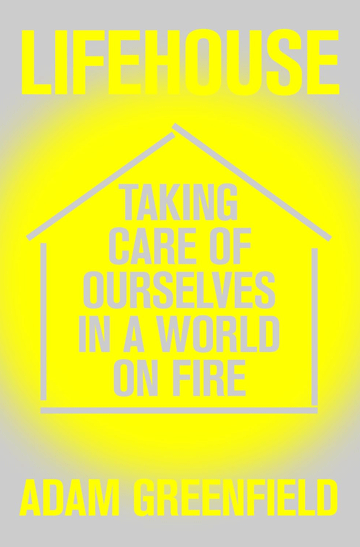
Books on climate change have gone through several phases over the last twenty years. There were the awareness raising books, then the alarm ringing ones as those were ignored. Then came the climate grief and anxiety books. On the other side of all three of those previous waves, there’s demand for something practical. Given that we are now living in a disrupted climate, what do we do?
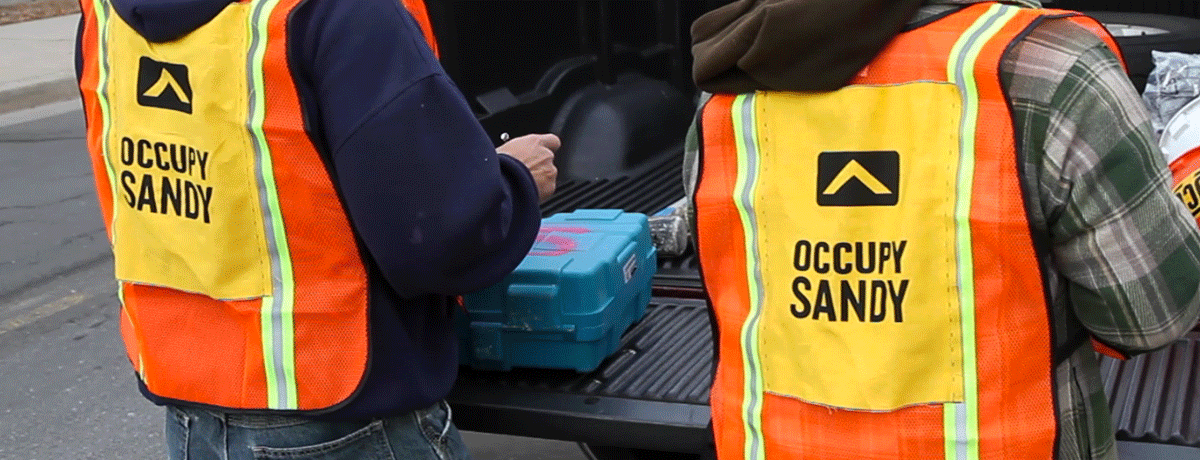
Lifehouse is such a book, as that subtitle makes clear: ‘taking care of ourselves in a world on fire’. It’s written by the urbanist Adam Greenfield and informed by some specific experiences. He was resident in New York during hurricane Sandy, and saw firsthand how communities can self-organise to respond to disaster. He helped out with the grassroots emergency response Occupy Sandy, and it was clearly a formative experience. If a community can organise successfully in a disaster situation, can we do something purposeful in the ‘long emergency’ of the climate crisis?
Occupy Sandy, you may remember, was a spontaneous citizen response to the catastrophic storm that hit New York in 2012. They mobilised some 60,000 volunteers and served 20,000 meals a day across dozens of makeshift centres. They were found to be ultimately more effective than the government’s FEMA response and also the Red Cross. As Greenfield explains, the fact that they had grown out of the Occupy movement was an important part of their success. People brought their principles of autonomy, solidarity, horizontal decision-making and direct action. They could get stuff done without waiting for anyone’s permission. The accusations often levelled against the movement – that they were naive, impractical and utopian – turned out to be entirely false when tested in this context.
The book goes on to describe similar moments from history, stories of “people doing something about conditions of life they had come to find intolerable. We read about Greece during the financial crisis. Another section looks at the Black Panthers and their ‘survival programmes’, activities that have perhaps been overlooked in the wider mythologising of the era. At its height, the Panthers provided a wide range of services to communities that were being neglected, often purposefully. Food programmes such as Free Breakfasts for Children were the largest, but there were others providing dentistry, ambulances, housing, free shoes, plumbing and maintenance, and even medical research into conditions that disproportionately affected black communities.
Greenfield keeps the tone conversational and exploratory, and doesn’t dig too much into theory. One exception is the thinking of Murray Bookchin, who advocated for ‘communalism’ rather than communism, and imagined this a kind of ‘libertarian municipalism’. Strangely enough, his ideas directly inspired the anarchist state of Rojava in Syria, and have been put into practice in its self-government.
Learning from these various stories, Greenfield lands us back in community responses to climate change with the specific suggestion in the title: Lifehouses. This is where you would find a food bank, a tool library, a warm hub in winter and a cool hub in summer. If the power went out, it would be solar powered and the place to go to recharge your phone. The Lifehouse would be a centre for community response and ideally within walking distance for everyone, looking to local needs and coordinating regionally on bigger challenges. Now based in the UK, Greenfield observes that churches are often best placed to be Lifehouses. (Some already are. My own church has a vegetable garden, free books, a tool library, a food bank and the biggest solar array in the neighbourhood, though it would not be able to articulate a philosophy of resilience or mutual aid.)
The author isn’t naive about the limits to these sorts of things. Mutual aid doesn’t come with any legal rights or minimum standards. You can’t appeal to any authority if you’re let down. It’s not going to replace other structures of decison making, but neither should we expect those legacy structures to be adequate. “Stop investing faith and energy in institutions that are demonstrably failing us,” he suggests, and invest in “local self-organised action” where we can.
We need more storytelling like this, more examples to learn from, and the idea of Lifehouses is explored further in the podcast Lifepod. Individualist societies naturally give rise to individualist crisis responses such as survivalism. This extricates the rich and the strong from the crisis, without doing anything to ease the suffering of everyone else. We will all be better off working together and getting started where the opportunities present themselves.
Governments aren’t equipped to deliver what we need, and so no amount of protest will get us very far. The billionaire philanthropists can’t help, and neither should we expect any miracle technologies. In the absence of this climate cavalry, we might want to put our energies behind “faith in the wisdom of ordinary people”.
- Lifehouse is available from Earthbound Books

