
In a significant first for the country and therefore the world, China has announced a climate target to reduce emissions (previous targets have only pledged a date for peak emissions). China tends to be a conservative target-setter and then beat them, so I would hope that will actually do better than its goal of a 7-10% decline by 2035.
An invitation to something “subversive and transformational — which is trying to end culture wars rather than win them.” Alex Evans writes about what churches can do to avoid the co-opting of Christianity by the far right, and the wisdom of this extends well beyond that particular audience.
I know you can get anything in the centre aisle of Aldi, but solar panels? Apparently in Australia, yes. And more use of solar panels to spell out words on rooftops please, as seen here.
With Morocco signing on recently, enough countries have now ratified the Marine Biodiversity Treaty for it to come into force, creating new protections against overfishing and deep-sea mining in international waters.
The latest series of Drilled, which bills itself as a true crime podcast about the climate, investigates obstruction – the coordinated effort to impede the building of renewable energy and move beyond fossil fuels.
Three recent articles and a bonus book review below.
Latest articles

Learning to live as a hot country: Madagascar
Earlier this year the Climate Change Committee, the UK’s climate advisory body, published a report on adaptation. Britain’s progress on reducing emissions has not been matched on the adaptation side. “There has been little progress on preparing ourselves for the changing climate,” they warn. As one of the guests at the launch event put it,…
What we learned this week
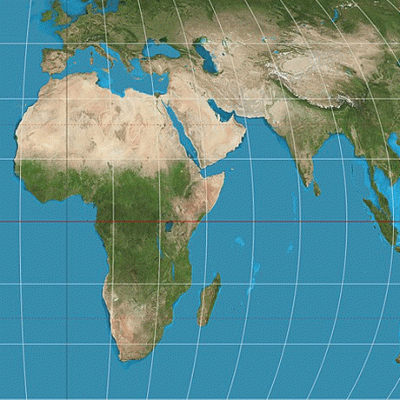
Much rejoicing from geography nerds around the world as the UN voted to formally retire the Mercator map of the earth in favour of the Equal Earth projection. If you haven’t seen this version, it shows the continents in their right sizes without the odd stretching of the similarly corrective Peters projection. Togo led the…

What are the alternatives to air conditioning?
Air conditioning was drawn into the culture wars this summer in the UK, joining a long list of things to be angry about, alongside flags, pronouns and National Trust scones. Now we have the tangled irony of people continuing to deny that climate change is real, while falsely claiming that they are being denied measures…
- The landscaper of the climate age
- Book review: Designing Hope, by Sarah Housley
- Marching for and marching against
Book review: Homo Aestheticus, by Samuel Alexander

Samuel Alexander is a director of the Simplicity Institute, author and professor at the University of Melbourne, Australia. I’ve reviewed several of his books over the years, including Simple Living in History, This Civilisation is Finished, and his speculative ‘lost dialogues of Diogenes’, Deface the Currency.
Homo Aestheticus is a distilled version of a longer book called S M P L C T Y, a collection of academic essays arguing that the universe can be understood as an evolving aesthetic phenomenon. That 400 page book becomes a 50 page volume here, written in an unusual aphoristic style. There are 525 numbered sentences or mini-paragraphs which the author calls “philosophical fragments”. A lot of thought went into this exercise, and it’s a book that rewards patient reading, despite its short length. I read it over the summer, taking it out to the picnic bench on the patio in the mornings with a cup of coffee. I’d often read a striking sentence and just sit with it for a while, looking at the trees and mulling it over. “Nature is more than an It (an object) but less than a Thou (a subject)” is one such fragment that I paused over.
The book argues that philosophies of industrial capitalism have led to machine-based metaphors of the universe, and sterile visions of progress as economic growth. What if we considered the universe as art instead, as an aesthetic event rooted in the beauty of nature and that we are invited to participate in. “What if the freedom to seek meaning and pleasure through creative activity is the mysterious purpose of the universe?”
Alexander doesn’t suggest that this is the ‘correct’ way to understand the world. It’s more of a set of evolving questions than a statement of truth, and its usefulness should be judged by trying it. “Consider living as if the purpose of the universe is to struggle towards beauty,” he suggests. “If life becomes progressively richer and more tranquil, continue along the path.”
When in the right frame of mind – those aforementioned sunny mornings in no particular hurry – I rather connected with Homo Aestheticus and appreciated the sideways nudge in thinking that these fragments provide. When I wasn’t in the right frame of mind, I found the book gnomic and opaque, as if the meaning lay just out of reach. You might not find those unhurried moments to take the book on its own terms, and so this isn’t a universal recommendation. But there’s a richness of thought here for those that can give it the time and reflection it needs.
Happily, Homo Aestheticus is available on a pay-what-you-like basis as an e-book, so you’re welcome to dip in and see for yourself.
 The Earthbound Report